"Why Did My Knees Deteriorate So Quickly?" — The Truth May Surprise You
One of the most common questions orthopedic specialists hear from patients is:
"Why did my knees deteriorate so quickly?"
It often feels as though the pain appeared overnight. A few months ago, climbing stairs was easy, sitting cross-legged wasn't a problem, and morning walks were enjoyable. Suddenly, every step becomes painful, the knees feel stiff, and daily activities begin to feel like a challenge.
But here's the reality: knee arthritis rarely develops overnight.
In most cases, the damage begins years before the first symptom appears. By the time pain, stiffness, and swelling become noticeable, the cartilage inside the knee may already have undergone significant wear and tear.
This is one of the biggest reasons why many Indians are diagnosed with knee arthritis much earlier than expected.
So, why does this happen? Let's understand the real reasons behind this growing orthopedic concern.
What Is Knee Arthritis?
Knee arthritis, also known as osteoarthritis of the knee, is a degenerative joint condition in which the protective cartilage covering the ends of the bones gradually wears away.
Healthy cartilage allows the knee to move smoothly without friction. As this cartilage becomes thinner, the bones begin rubbing against each other, leading to pain, inflammation, stiffness, and reduced mobility.
Although arthritis is often associated with ageing, it is increasingly affecting people in their 40s—and sometimes even earlier.
Knee Arthritis Is Not Just an Age-Related Disease
One of the biggest misconceptions about knee arthritis is that it only happens because of old age.
While ageing does increase the risk, it is rarely the only reason.
For many patients, knee arthritis develops due to years of unnoticed joint damage caused by multiple factors working together.
Rather than a single cause, it is often the result of accumulated stress placed on the knee over decades.
This is why someone in their early forties may develop severe arthritis, while another person in their sixties continues to walk comfortably.
Why Do Indians Develop Knee Arthritis Earlier?
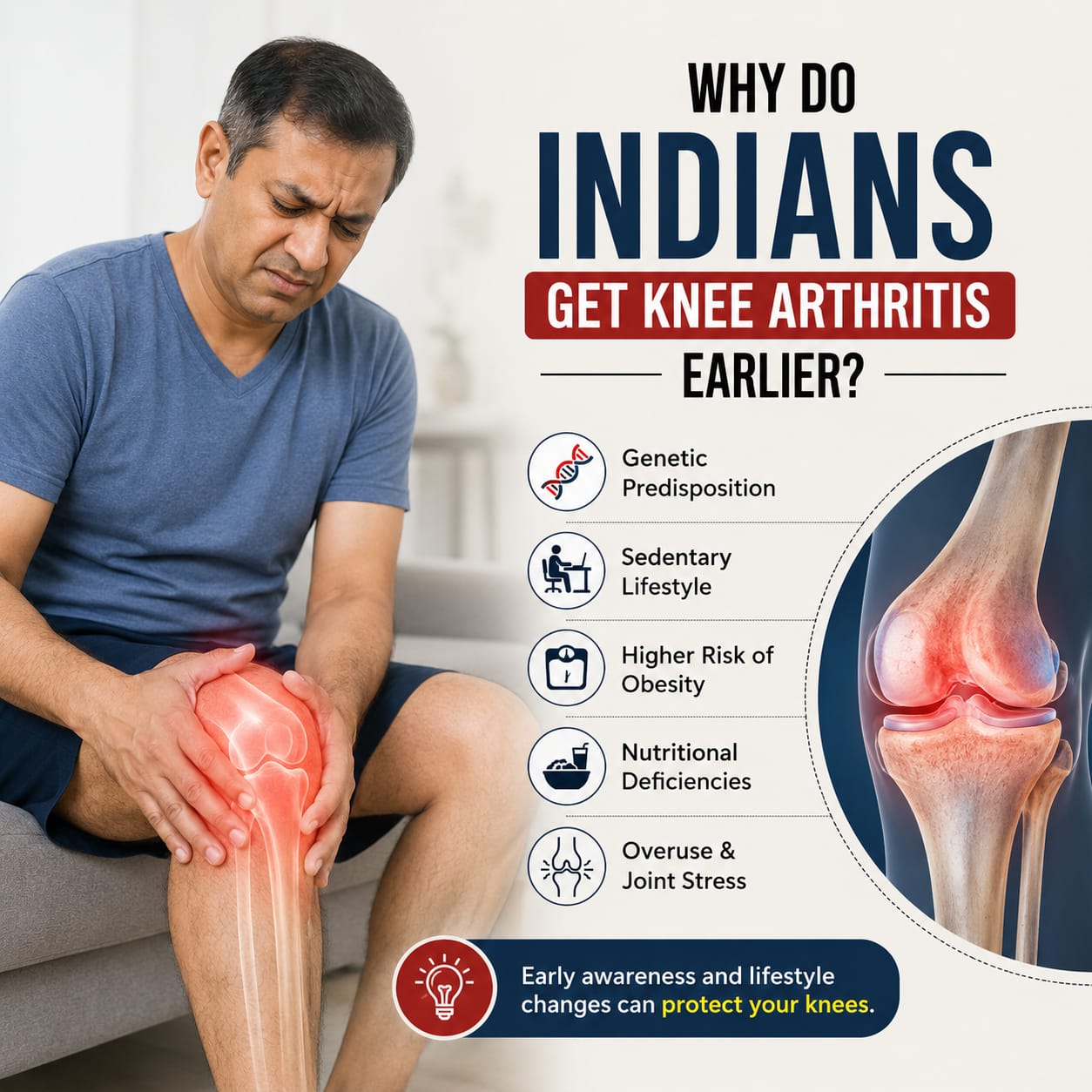
Several lifestyle, medical, and biological factors contribute to the earlier onset of arthritis among Indians.
1. Old Ligament Injuries That Were Never Properly Treated
A previous ligament injury—especially an ACL or PCL injury—can permanently alter the stability of the knee.
Many people ignore these injuries once the pain subsides and return to normal activities without complete rehabilitation.
Unfortunately, an unstable knee experiences abnormal movement, increasing pressure on the cartilage year after year. Eventually, this accelerates arthritis.
2. Untreated Meniscus Damage
The meniscus acts as the knee's natural shock absorber.
When a meniscus tear is left untreated, the protective cushioning inside the knee becomes compromised.
As a result, the cartilage bears greater pressure with every step, gradually leading to faster joint degeneration.
Many patients don't even realise they had a meniscus injury until arthritis has already developed.
3. Obesity Places Constant Pressure on the Knees
Every extra kilogram of body weight significantly increases the force transmitted through the knee joint while walking, climbing stairs, or standing.
Over time, this continuous overload speeds up cartilage wear.
With obesity becoming increasingly common in India, it has become one of the leading contributors to early knee arthritis.
4. Muscle Weakness Reduces Joint Support
Strong muscles around the knee act like natural shock absorbers.
Weak quadriceps, hamstrings, gluteal muscles, and calves force the knee joint to bear more stress than it is designed to handle.
Unfortunately, modern sedentary lifestyles have resulted in weaker muscles and greater joint strain.
5. Years of Excessive Joint Loading
Many Indians unknowingly place repeated stress on their knees through everyday activities, such as:
- Frequent squatting
- Sitting cross-legged for long periods
- Climbing multiple flights of stairs daily
- Carrying heavy loads
- High-impact exercises without proper conditioning
Individually, these activities may not seem harmful.
However, when repeated over decades, they gradually increase wear and tear on the knee cartilage.
6. Vitamin D and Calcium Deficiency
Vitamin D deficiency is extremely common in India.
Low Vitamin D affects bone strength, muscle function, and overall joint health.
Combined with inadequate calcium intake, it may contribute to poor support for the knee joint and increase the likelihood of orthopedic problems.
7. Lack of Physical Activity
Ironically, both excessive activity and too little activity can damage the knees.
Long hours of sitting weaken supporting muscles, reduce flexibility, and increase stiffness.
Without strong muscles to protect the joint, cartilage experiences greater stress during even routine movements.
8. Genetics Also Plays a Role
Some individuals inherit a greater tendency to develop osteoarthritis.
If close family members have experienced early knee arthritis, the risk may be higher.
However, genetics alone rarely determines the outcome. Lifestyle choices significantly influence how quickly arthritis develops.
The Biggest Problem: Knee Damage Starts Long Before the Pain
One of the most overlooked aspects of knee arthritis is that cartilage has no pain nerves.
This means the cartilage can gradually wear away for years without producing obvious symptoms.
During this silent phase, patients continue walking, exercising, climbing stairs, and carrying out their daily routines—often unaware that their knee joint is slowly deteriorating.
By the time pain begins, the damage may already be moderate or even advanced.
This is why waiting for severe pain before consulting an orthopedic specialist is one of the biggest mistakes people make.
Early Signs You Should Never Ignore
Don't wait until walking becomes difficult.
Watch for these warning signs:
- Pain while climbing stairs
- Knee stiffness in the morning
- Pain after prolonged sitting
- Swelling around the knee
- Clicking or grinding sounds with pain
- Difficulty squatting
- Reduced walking distance
- Knee pain after exercise
These symptoms often indicate that the joint needs professional evaluation.
Can Early Knee Arthritis Be Prevented?
While ageing cannot be stopped, the progression of arthritis can often be slowed considerably.
Maintain a Healthy Weight
Reducing body weight decreases the load on the knees and protects cartilage.
Strengthen the Muscles Around the Knee
Strong muscles improve stability and reduce joint stress.
Stay Physically Active
Walking, cycling, swimming, and guided strengthening exercises help maintain healthy joints.
Don't Ignore Knee Injuries
Old ligament injuries and meniscus tears should always be evaluated and treated appropriately.
Correct Nutritional Deficiencies
Adequate Vitamin D, calcium, and protein intake support bone and muscle health.
Seek Early Orthopedic Evaluation
Persistent knee pain is never "normal". Early diagnosis often prevents long-term damage.
Modern Treatment Options for Knee Arthritis
Treatment depends on the stage of arthritis and the patient's lifestyle.
Options may include:
- Lifestyle modification
- Weight management
- Physiotherapy
- Muscle strengthening
- Pain management
- Knee braces
- GFC (Growth Factor Concentrate) therapy in suitable patients
- PRP therapy where indicated
- Hyaluronic acid injections
- Arthroscopic procedures in selected cases
- Knee replacement surgery for advanced arthritis
The objective is always to relieve pain, improve mobility, and preserve the natural joint whenever possible.
When Should You Consult an Orthopedic Specialist?
If knee pain lasts longer than two weeks, keeps returning, or begins affecting your daily activities, it is time for a professional evaluation.
Early consultation allows the condition to be diagnosed before irreversible cartilage damage occurs.
If you are searching for an experienced orthopedic doctor in Vaishali, timely assessment can help identify the root cause of knee pain and provide treatment tailored to your condition.
At My Ortho Centre, comprehensive evaluation and advanced treatment options are available for arthritis, sports injuries, ligament tears, meniscus injuries, and other orthopedic conditions. Under the expertise of Dr Mohit Madan, Orthopedic, the focus is on preserving joint health, restoring mobility, and helping patients return to an active lifestyle.
Recognized by many patients as a trusted destination for the Best Orthopedic in Ghaziabad, the emphasis is always on early diagnosis, evidence-based treatment, and long-term joint preservation.