Most people who end up reading about shoulder arthroscopy surgery never planned to. They did not wake up one day thinking about surgery. They came here because something did not add up.
The pain was supposed to go away. The physiotherapy sessions were supposed to fix it. The exercises were supposed to make the shoulder stronger. And for a while, they did. But then the pain returned. Sometimes slowly. Sometimes suddenly. And each time it came back, it felt a little more stubborn than before.
One patient at MyOrtho Centre once said something very simple. “Doctor, I am not in unbearable pain. I am just tired of protecting my shoulder all the time.” That sentence explains more than any scan ever could.
When Shoulder Pain Stops Being “Normal”?
Not all shoulder pain is serious. That part matters. If your shoulder hurts after a long day of work, a workout, or sleeping in an awkward position, that usually settles. Muscles get tired. Tendons get irritated. Physiotherapy works beautifully in these cases.
The problem begins when pain changes its behaviour.
When pain wakes you up at night.
When lifting your arm feels weak, not just painful.
When turning in bed causes a sharp catch inside the joint.
When you stop trusting your shoulder during simple movements.
At that point, people start searching things like why does my shoulder pain keep coming back or how long is too long for physiotherapy. That is usually the moment when the shoulder is no longer dealing with a simple strain.
Why Physiotherapy Sometimes Feels Like It Works, Until It Doesn’t?
Physiotherapy is powerful, but it has limits. Think of it like strengthening the walls of a house when the problem is a cracked foundation. The house feels stable for a while. But the crack remains.
Inside the shoulder joint, small tears can exist without obvious symptoms at first. A partial rotator cuff tear. A labral injury. A stretched ligament. Exercises strengthen surrounding muscles, so pain reduces. Movement improves. Everyone feels hopeful.
But the damaged structure inside does not heal on its own.
So the pain returns. Often after a few weeks. Sometimes after months. And each return feels more discouraging than the last. This is when doctors start discussing arthroscopic shoulder surgery, not because physiotherapy failed, but because it reached the limit of what it can fix.
A Situation Many Patients Recognise Instantly
Imagine someone in their late thirties. Office job. Occasional gym sessions. No major accident. Just a slow buildup of shoulder pain. When physiotherapy helps, then pain reduces and life moves on.
Then one day, reaching for a bag in the car causes a sharp pain. From that day, the shoulder never feels the same again. Exercises still help a little, but the shoulder feels unreliable. Weak. Unpredictable.
Scans reveal a tear that has been there for a while. In this situation, continuing only exercises does not solve the problem. The shoulder needs internal repair. That is where shoulder arthroscopy surgery becomes a solution, not a failure.
What Shoulder Arthroscopy Surgery Really Means?
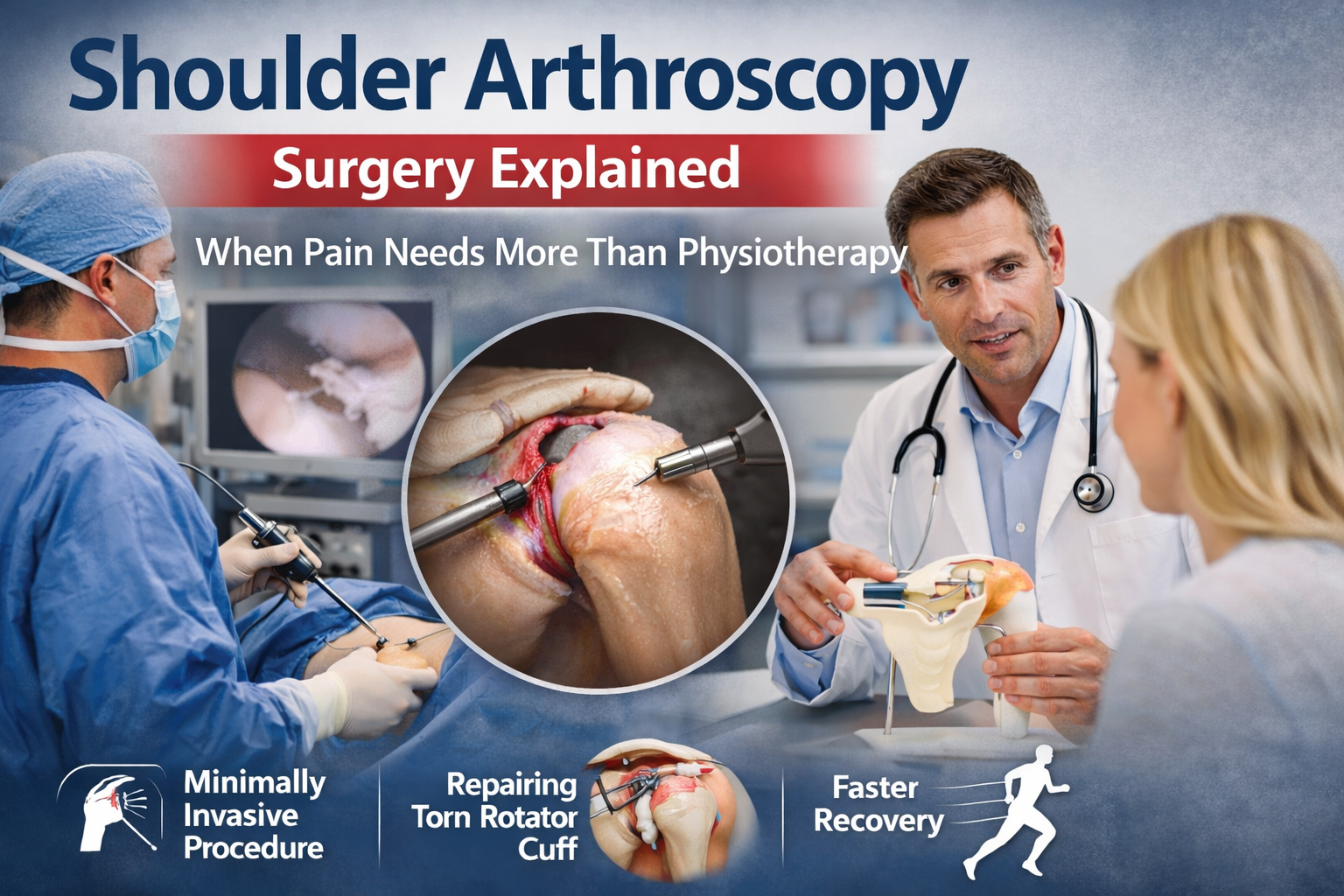
The word surgery scares people, especially when it involves the shoulder. But shoulder arthroscopy surgery is not what most people imagine. There is no large cut. No major muscle damage. No long hospital stay.
A small camera goes inside the joint. The surgeon sees exactly what is damaged. Nothing is guessed. Nothing is assumed. The tear is either there or it is not. The ligament is either loose or it is not.
That clarity changes everything.
Through the same small openings, repairs are done precisely. This is why arthroscopic shoulder surgery has transformed shoulder treatment over the years.
Why Shoulder Ligament Repair Is Often Delayed Too Long?
Shoulder instability is tricky. Many patients do not realise their shoulder is unstable. They just feel it is “not right”. A sense that the shoulder may slip. A fear during certain movements. A lack of confidence while lifting. This often points toward ligament damage.
Shoulder ligament repair is most successful when done before repeated damage occurs. Waiting too long can lead to cartilage wear and long-term joint problems. Many patients later say they ignored early signs because the pain was not constant.
The Question Everyone Asks but Hesitates to Say Out Loud
“Doctor, will my shoulder ever feel normal again?” It is a fair question. The goal of shoulder joint injury treatment is not just pain relief. It is restoring trust in movement. Being able to lift, reach, sleep, and work without hesitation.
When surgery is done at the right time, recovery is often smoother than people expect. Not instant. Not magical. But steady and reliable.
Recovery Is a Process, Not a Deadline
One thing My Ortho Centre explains clearly to patients is this. Surgery fixes structure. Rehabilitation restores function. After arthroscopic shoulder surgery, healing happens in phases. First comes protection. Then controlled movement. Then strength. Rushing this process creates setbacks. Respecting it builds lasting recovery.
Patients who understand this early tend to do better emotionally and physically.
Why Can Waiting Make Things Harder?
Many people delay surgery out of fear. That fear is understandable. But delays sometimes make recovery longer. Small tears become larger. Muscles weaken. Repair becomes more complex. Recovery takes more time. This does not mean surgery is urgent for everyone. It means timely evaluation matters.
How Decisions Are Made at My Ortho Centre?
Not every shoulder pain that walks into My Ortho Centre walks out with a surgical plan. Some are advised continued physiotherapy. Some need lifestyle changes. Some need time. But when surgery is suggested, it is because the shoulder has reached a point where non-surgical care is no longer enough.
That honesty is important.
When Shoulder Arthroscopy Surgery Makes Sense
Not every shoulder pain needs surgery. And not every tear needs immediate repair. At My Ortho Centre, the focus is on precise diagnosis before recommending any procedure. Imaging studies, clinical examination, and patient lifestyle are carefully considered.
This approach avoids unnecessary surgery while ensuring timely intervention when needed. At My Ortho Centre, shoulder care is not rushed. Each patient is evaluated individually. Surgery is recommended only when it genuinely improves quality of life.
If pain keeps returning despite effort.
If daily activities feel restricted.
If sleep is affected.
If scans show structural damage.
Then shoulder arthroscopy surgery is not something to fear. It is something to consider calmly.
A Final Thought
Shoulder pain does not always shout. Sometimes it whispers for years. People adjust. They compensate. They avoid it. But shoulders are meant to move freely. Not cautiously.
Understanding when pain needs more than physiotherapy is not about choosing surgery early. It is about choosing clarity at the right time. At My Ortho Centre, that clarity comes first and always. Whenever you think your symptoms are moving far beyond shoulder pain, and your doctor has suggested to go for shoulder arthroscopy surgery, then consider My Ortho Centre to get the treatment. We have trained, experienced and qualified doctors to help you get the relief.