Recovering from knee replacement surgery is one of the biggest concerns for patients living with severe knee arthritis. While pain relief is often the primary goal, many people also want to know how quickly they can return to walking, climbing stairs, and enjoying their daily activities. Thanks to advancements in Orthopedic technology, Augmented Reality (AR) is transforming the way knee replacement surgeries are performed. But can it actually reduce recovery time?
The answer is encouraging, but it is important to understand how this technology works. Augmented Reality does not directly speed up the body's natural healing process. Instead, it helps surgeons perform knee replacement with greater precision, which may contribute to better joint function, improved implant positioning, and a smoother rehabilitation journey for many patients.
What Is Augmented Reality Knee Replacement?
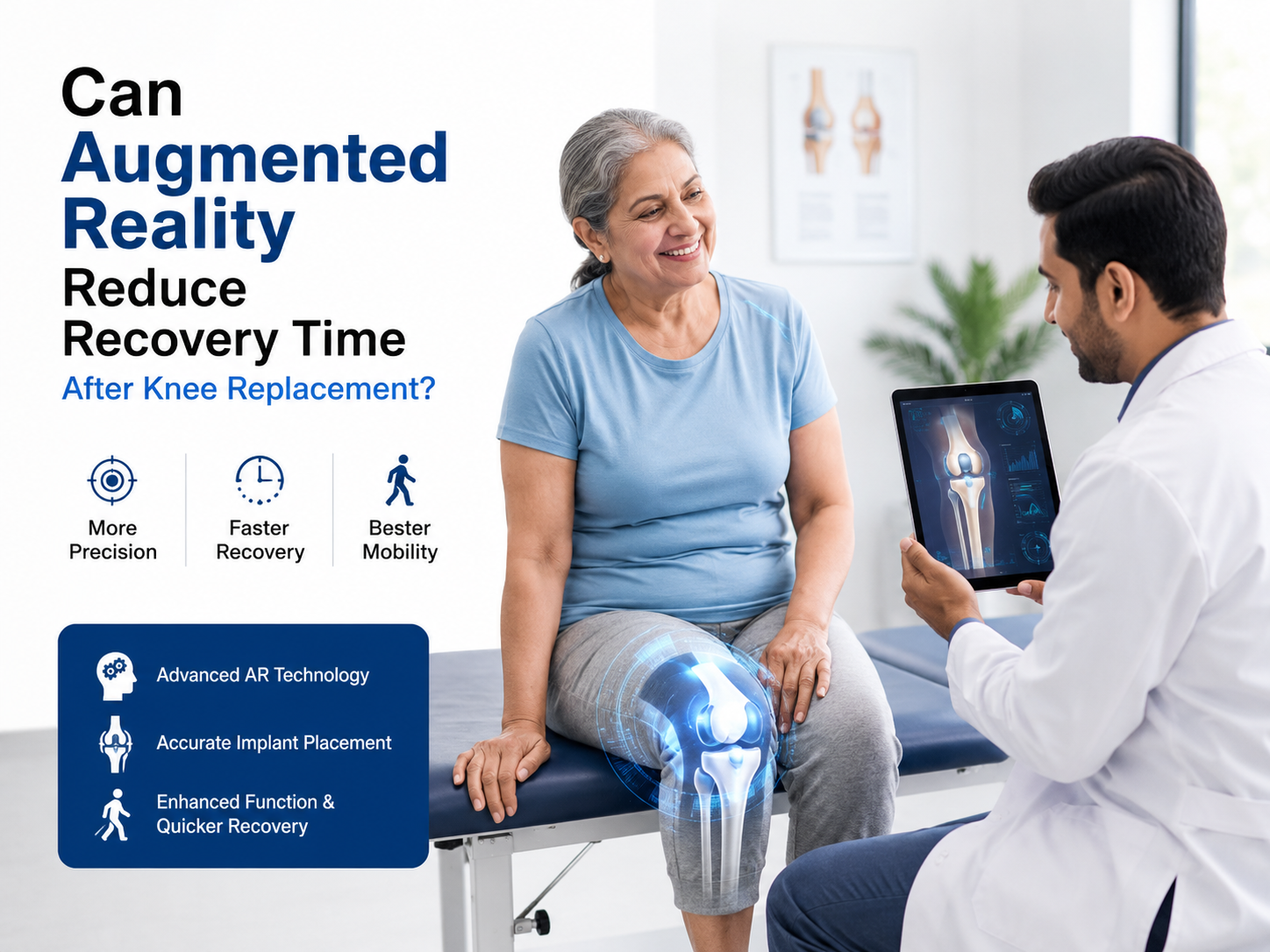
Augmented Reality (AR) Knee Replacement is an advanced surgical navigation technique that provides the surgeon with real-time visual guidance during Total Knee Replacement (TKR). Using specialized AR smart glasses and tracking markers attached to the patient's leg, the system displays important information such as bone alignment, implant positioning, and limb mechanics directly within the surgeon's field of view.
Unlike robotic surgery, the surgeon performs every step of the procedure. The AR system simply acts as a navigation tool that enhances accuracy and supports better surgical decision-making.
How Can Augmented Reality Influence Recovery?
Recovery after knee replacement depends on several factors, including the patient's age, overall health, physiotherapy, and surgical technique. While AR technology does not guarantee faster healing, it can create conditions that may support a smoother recovery.
Some potential benefits include:
- More accurate implant positioning
- Better restoration of the knee's natural alignment
- Improved joint stability
- Balanced weight distribution across the knee
- Enhanced movement and function after surgery
When the artificial knee is positioned accurately, patients may experience improved comfort during rehabilitation and better long-term joint performance.
Why Surgical Precision Matters
Successful knee replacement is about much more than replacing damaged cartilage. Every bone cut, implant angle, and alignment measurement plays an important role in how the new joint functions.
Even small variations in implant positioning can influence:
- Walking pattern
- Knee stability
- Range of motion
- Weight distribution
- Implant longevity
- Overall patient satisfaction
Advanced navigation systems help surgeons verify these measurements throughout the procedure, allowing adjustments whenever necessary.
Benefits of Augmented Reality Knee Replacement
Modern AR-assisted knee replacement offers several advantages compared with conventional techniques.
Improved Implant Alignment
Accurate implant positioning helps restore the natural mechanics of the knee, allowing smoother movement after surgery.
Real-Time Surgical Guidance
The surgeon receives continuous feedback throughout the procedure, improving precision without taking attention away from the surgical field.
Personalized Surgery
Every patient's knee anatomy is different. AR navigation helps tailor the procedure according to individual anatomical variations rather than relying solely on conventional guides.
Better Functional Outcomes
Improved alignment may support better knee function and mobility, helping patients regain confidence during daily activities.
Enhanced Surgical Confidence
The technology provides additional verification throughout surgery while allowing the surgeon to remain fully in control of every step.
Does Everyone Recover Faster?
Not necessarily.
Recovery is influenced by multiple factors, including:
- Age and overall fitness
- Severity of arthritis
- Bone quality
- Muscle strength
- Existing medical conditions such as diabetes
- Commitment to physiotherapy
- Following post-operative instructions
Even with the most advanced technology, rehabilitation remains an essential part of successful recovery.
Augmented Reality vs Conventional Knee Replacement
|
Feature |
Conventional Surgery |
Augmented Reality Surgery |
|
Surgical Guidance |
Manual instruments |
Real-time navigation |
|
Implant Alignment |
Conventional measurement |
Digitally verified |
|
Visualization |
Standard surgical view |
Enhanced visual guidance |
|
Precision |
Surgeon dependent |
Surgeon supported by AR technology |
|
Technology |
Traditional instrumentation |
Advanced navigation assistance |
While both techniques can provide excellent results, Augmented Reality offers additional intraoperative guidance that may improve surgical accuracy.
Who May Benefit from AR-Assisted Knee Replacement?
Augmented Reality-assisted knee replacement may be considered for patients experiencing:
- Advanced osteoarthritis
- Chronic knee pain
- Severe joint damage
- Knee deformity
- Difficulty walking
- Failure of conservative treatment
A detailed clinical examination by an experienced orthopedic specialist is necessary to determine the most appropriate treatment approach.
Recovery Timeline
Although recovery varies from patient to patient, a general timeline includes:
First Week
- Pain management
- Assisted walking
- Gentle physiotherapy
- Knee mobility exercises
Two to Six Weeks
- Reduced swelling
- Improved flexibility
- Better walking ability
- Increased independence
Six Weeks to Three Months
- Improved muscle strength
- Better balance
- Return to many routine activities
- Continued rehabilitation
Following the rehabilitation program recommended by the surgeon plays a significant role in achieving the best possible outcome.
Choosing the Right Orthopedic Specialist
Advanced technology delivers the greatest benefits when combined with surgical expertise. When considering knee replacement, patients should look for an experienced Orthopedic doctor in Vaishali who specializes in joint replacement procedures and follows evidence-based surgical practices.
Dr. Mohit Madan focuses on comprehensive orthopedic care, combining clinical expertise with modern surgical techniques to help patients achieve improved mobility and long-term joint function. At Dharamshila Narayana Hospital, a trusted Bone and Joint Care Center in Ghaziabad, every patient receives a personalized evaluation to determine whether advanced technologies such as Augmented Reality-assisted knee replacement are suitable for their condition.
Final Thoughts
Augmented Reality is changing the future of knee replacement surgery by enhancing surgical precision and supporting accurate implant positioning. Although it does not directly reduce the body's healing time, greater accuracy during surgery may help improve joint function and create favorable conditions for a smoother recovery.
If you are considering knee replacement surgery, consult an experienced orthopedic specialist to understand which treatment option is best for your condition. A thorough evaluation, the right surgical approach, and a dedicated rehabilitation program remain the key factors in achieving long-lasting pain relief and improved quality of life.