Choosing the right technology for knee replacement surgery is just as important as selecting the right surgeon. With advancements in orthopedic care, patients today have access to conventional knee replacement, robotic-assisted surgery, and the latest innovation—Augmented Reality (AR) Knee Replacement. Each technique aims to relieve pain and restore mobility, but they differ in terms of surgical guidance, precision, and technology.
Augmented Reality Knee Replacement is transforming the way orthopedic surgeons perform Total Knee Replacement (TKR) by providing real-time navigation throughout the procedure. For patients looking for an experienced Orthopedic doctor in Vaishali, understanding the differences between these surgical approaches can help make an informed treatment decision based on individual needs and medical condition.
What is Augmented Reality Knee Replacement?
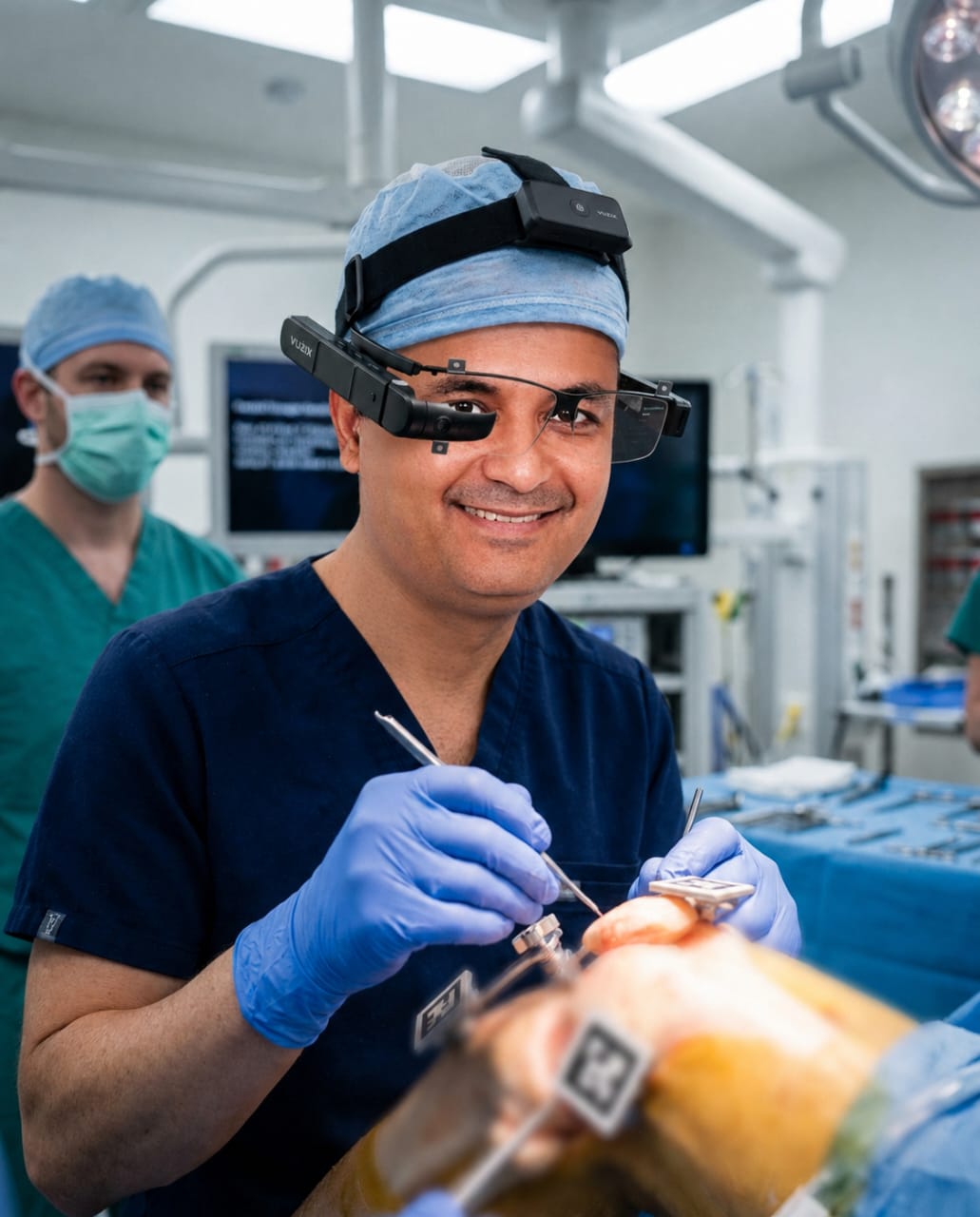
Augmented Reality (AR) Knee Replacement is an advanced surgical technique that uses Pixee Knee (Knee+), an innovative AR-based navigation system, to assist orthopedic surgeons during Total Knee Replacement surgery. Unlike robotic systems that use robotic arms or conventional methods that rely primarily on manual instruments, AR technology overlays real-time digital information directly into the surgeon's field of view through smart glasses.
During the procedure, lightweight tracking markers are temporarily attached to the femur and tibia. These markers continuously provide data about the patient's knee alignment, bone cuts, mechanical axis, and implant positioning. This real-time visualization enables the surgeon to make accurate adjustments while maintaining complete control of every surgical step.
The goal of Augmented Reality Knee Replacement is to improve implant alignment, optimize joint balance, and support long-term implant performance without requiring bulky robotic equipment. It combines the expertise of the orthopedic surgeon with advanced digital navigation, offering precision while preserving the surgeon's decision-making throughout the operation.
How Does Augmented Reality Improve Knee Replacement Surgery?
Traditional knee replacement depends largely on manual instruments and the surgeon's experience to achieve proper alignment. Robotic-assisted surgery introduces computer-guided planning with robotic assistance during certain parts of the procedure. Augmented Reality takes a different approach by providing continuous visual guidance without replacing the surgeon's hands.
Using AR smart glasses, the surgeon receives live information about bone alignment, implant positioning, limb mechanics, and surgical accuracy throughout the operation. This immediate feedback allows for precise adjustments, helping ensure that each surgical step is performed according to the planned alignment while maintaining a smooth surgical workflow.
Benefits of Augmented Reality Knee Replacement
Augmented Reality technology offers several advantages that make it an exciting advancement in modern orthopedic surgery.
Some of its key benefits include:
- Real-time visualization throughout surgery.
- Enhanced accuracy of implant positioning and limb alignment.
- Improved assessment of the mechanical axis during the procedure.
- Lightweight and portable technology compared with bulky robotic systems.
- No robotic arm controlling surgical instruments.
- Allows the surgeon to remain in complete control of every surgical step.
- Efficient surgical workflow with advanced digital navigation.
- Supports consistent surgical planning and execution.
- May contribute to improved implant longevity through optimized alignment.
- Combines advanced technology with the expertise of the orthopedic surgeon.
Although technology enhances precision, successful outcomes also depend on the surgeon's experience, implant selection, rehabilitation, and patient commitment to recovery.
Augmented Reality vs Robotic vs Conventional Knee Replacement
|
Feature |
Conventional Surgery |
Robotic Surgery |
Augmented Reality Surgery |
|
Surgical Guidance |
Manual instruments |
Robotic-assisted navigation |
Real-time AR navigation |
|
Implant Alignment |
Manual assessment |
Computer-assisted |
Continuous digital visualization |
|
Technology |
Standard instruments |
Robotic platform |
Smart glasses with AR navigation |
|
Surgeon Control |
Complete |
Surgeon with robotic assistance |
Complete |
|
Equipment |
Basic |
Large robotic system |
Lightweight AR system |
|
Precision |
Experience dependent |
High |
High with real-time guidance |
While all three techniques aim to relieve pain and restore joint function, Augmented Reality combines advanced navigation with surgical expertise, offering enhanced precision without relying on robotic hardware.
Who Can Benefit from Augmented Reality Knee Replacement?
Patients with advanced knee osteoarthritis, severe cartilage damage, persistent knee pain, joint deformity, or reduced mobility that has not improved with medications, physiotherapy, injections, or lifestyle modifications may benefit from Augmented Reality Knee Replacement. A detailed orthopedic evaluation helps determine the most appropriate surgical approach based on each patient's condition, anatomy, and treatment goals.
Why Choose Dr. Mohit Madan & My Ortho Center?
Patients seeking advanced joint replacement solutions can consult Dr. Mohit Madan, an experienced Orthopedic specialist dedicated to evidence-based care and modern surgical techniques. At My Ortho Center, a trusted Bone and Joint Care Center in Ghaziabad, every patient undergoes a comprehensive assessment and receives a personalized treatment plan. Individuals searching for the best orthopedic doctor in Ghaziabad or an experienced Orthopedic doctor in Vaishali can benefit from specialized orthopedic care focused on restoring mobility and improving quality of life.
Book a Consultation
If chronic knee pain is affecting your mobility and daily activities, consult Dr. Mohit Madan at My Ortho Center to learn whether Augmented Reality Knee Replacement is the right option for you. An early consultation with an experienced Orthopedic doctor in Vaishali can help you understand the most suitable treatment approach and take the first step toward pain-free movement.